$20.00
We will hold your cart for 15:00.
You’ve finally decided to upgrade from that $30 block set from the big-box store. Or maybe you’re building your first serious knife kit and you’re drowning in options. Either way, you’ve landed on Wüsthof – a brand that’s been forging knives in Solingen, Germany, since 1814. That’s over two centuries of edge geometry, steel composition, and handle design honed to one goal: making prep work faster and safer.
But here’s the problem. Wüsthof makes eight different blade lines, dozens of individual knives, and enough block sets to confuse anyone. Walk into any store and you’ll see a 20-piece block for under $200, and a 12-piece block for $800. Which one is right for you?
I’ve spent the last decade testing kitchen knives both at home and in professional prep kitchens. In this guide, I’ll break down exactly which Wüsthof block sets are worth your money, which ones you should skip, and the three knives you should buy even if you never buy a block. By the end, you’ll know exactly what to put on your cutting board – and what to leave on the shelf.
Before we compare block sets, let’s get one thing straight. Wüsthof isn’t the only German knife maker. Zwilling (Henckels), Messermeister, and F. Dick all make fine blades. But Wüsthof has a few advantages that keep it at the top of most professional and serious home cooks’ lists:
But here’s the thing: Wüsthof makes both forged and stamped knives. The stamped ones, like the Gourmet line, are lighter, more flexible, and cheaper. The forged ones – Classic, Ikon, Classic Ikon, Epicure, Performer, Amici, and Crafter – are heavier, more balanced, and more durable. If you’re spending money on a block set, you want to know which line you’re getting.
Here’s a quick cheat sheet for the most popular Wüsthof lines you’ll encounter in block sets:
| Line | Construction | Handle | Best for |
|---|---|---|---|
| Classic | Forged, full tang | Polyoxymethylene (POM) – black, triple-riveted | The standard. Balanced, grippy, dishwasher-safe (but don’t). |
| Classic Ikon | Forged, full tang | Ergonomic, contoured, with a slight finger guard | Cooks who want a more comfortable grip for extended prep. |
| Ikon | Forged, full tang | Ergonomic, no rivets, black walnut or POM | Sleek looks and a seamless handle. Often more expensive. |
| Epicure | Forged, full tang | Rounded, pronounced finger guard, larger bolster | Rocking-style choppers who prefer a heavier blade and full bolster. |
| Gourmet | Stamped | POM, triple-riveted | Budget-friendly, lighter weight, still Solingen steel. |
| Crafter | Forged, full tang | Beautiful walnut wood with brass rivets | Gift-worthy, natural aesthetics, but requires more care. |
| Amici | Forged, full tang | D-shaped, polished steel | Professional feel, minimalist design, more expensive. |
| Performer | Forged, full tang | Ergonomic, textured polymer | Maximum grip, even when wet – great for heavy prep. |
For most home cooks, Classic is the sweet spot. It’s the line that’s been the standard for decades, and it’s the one you’ll find on most professional kitchen magnets. If you have larger hands or want a touch more comfort, Classic Ikon is worth the premium. If you’re price-conscious, Gourmet is a solid entry point, but you’ll miss the heft.
Let’s be honest: most block sets are filled with knives you’ll never use. That 15-piece set comes with a carving fork, a carving knife you’ll break out twice a year, and three different utility knives that all do the same thing. If you buy a set just because it looks impressive, you’re paying for steel that’ll sit untouched in the block.
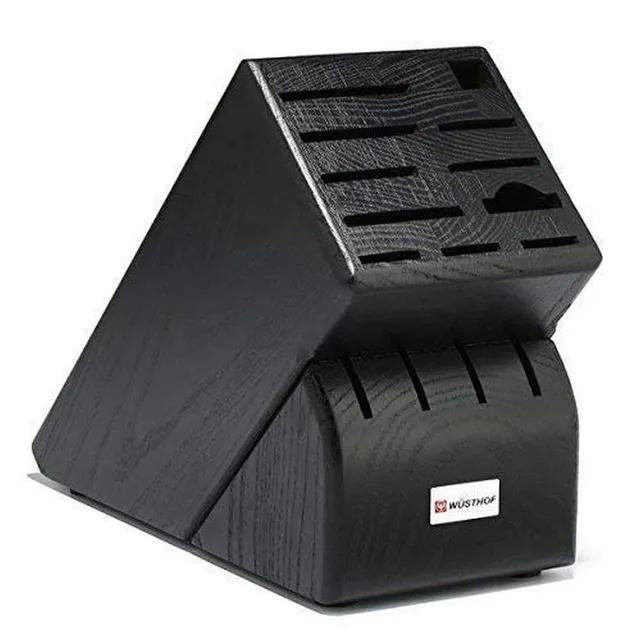
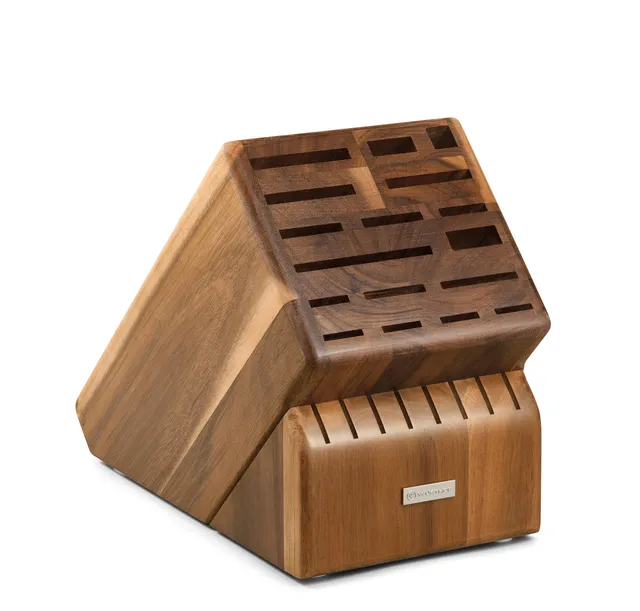
Here’s the better approach: buy the knives you’ll actually use, then store them in a slot block that fits your counter. That’s why I’m such a fan of the Wüsthof 15-Slot Black Knife Storage Block and the Wüsthof 25-Slot Acacia Knife Storage Block. These blocks let you start with a few essential knives and expand later, without buying a predetermined set.
Want a real-world example? Here’s what I’d put in a 15-slot block:
That’s nine pieces. The other six slots? You can add a boning knife, a santoku, a slicing knife, or even a spare chef’s knife if you’re serious about prep work. You’re not forced into a pattern you won’t use.
Wüsthof sells several pre-sized block sets – from 6-piece to 41-piece monsters. But you’ll often pay a premium for the knife block itself, and you’ll get knives you don’t need. Let’s compare two real-world options.
Option A: The Wüsthof Classic 9-Piece Block Set – retails around $450. You get an 8” chef’s knife, 6” chef’s knife, 9” bread knife, 5” serrated utility knife, 4” paring knife, 3” paring knife, kitchen shears, sharpening steel, and a 15-slot block. That’s a solid set, and the price is reasonable for the quality. But if you already have some knives, you’re paying for duplicates.
Option B: Build your own with the 15-slot block – buy the block for $84, then pick individual knives. On sale, you can often get an 8” Classic chef’s knife for around $100, a paring knife for $40, a bread knife for $70, and shears for $30. That’s about $324 for the same core set, saving you over $100. And you can choose a different handle style if you prefer Ikon or Epicure.
So, if you’re starting from scratch, a pre-made set can be a hassle-free option. But if you already own one or two decent knives, building your own collection with a standalone block is smarter.
No matter how good your knives are, they’ll dull. And a dull knife is more dangerous than a sharp one – it slips and requires more force. That’s why any serious knife collection needs a sharpening plan.
Wüsthof makes a distinction between honing and sharpening. Honing with a steel doesn’t remove metal; it realigns the edge. Sharpening with a whetstone or electric sharpener removes a tiny bit of metal to create a new edge. You should hone your knives every few uses, and fully sharpen them every six months to a year, depending on how much you cook.
That’s where the Wüsthof 10” Sharpening Steel comes in. It’s the perfect companion to any Wüsthof block. The steel is magnetized to catch fine metal particles, and the handle is comfortable to grip. If you buy nothing else, buy this.
If you’re ready to start or upgrade your collection, here are the specific pieces I recommend – and why.
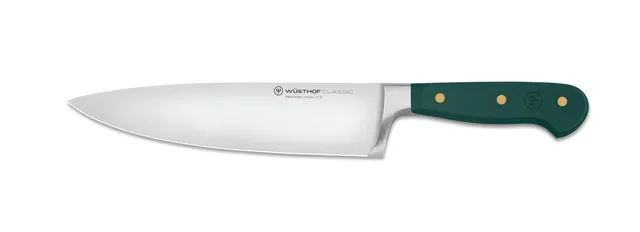
The 8” Chef’s Knife is the one knife you’ll use for 80% of your prep. This Fresh Rosemary edition has the same Classic blade but with a beautiful rosemary-and-olive wood handle. It’s a limited-edition look that’s both elegant and practical. At $204, it’s a bit above the standard Classic, but you get a handle that’s truly unique. If you want the standard black handle, it’s often $30–40 less.
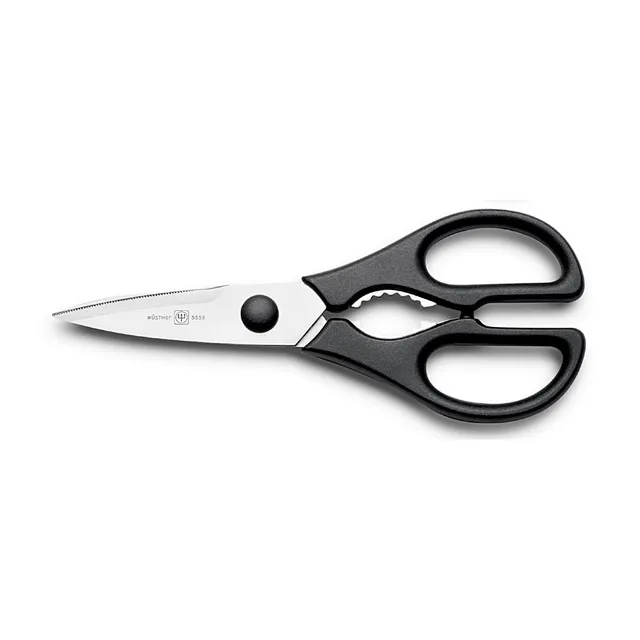
Wüsthof Come-Apart Kitchen Shears are not your grandmother’s scissors. These are precision-forged, high-carbon stainless steel with a design that comes apart for easy cleaning. You can use them for everything from trimming chicken breasts to snapping green beans. Plus, there’s a jar opener built into the handle – a small but brilliant touch. At $30, they’re a steal.
And if you’re going to buy knives, you need a safe place to store them. The 15-slot black block is a clean, space-saving design that fits most kitchen counters. It has a low profile, and the slots are designed to hold both wide and narrow blades.
The 10” Honing Rod is the one tool that will make your knives last for decades. Use it often, and you’ll only need full sharpening once a year. It’s a must-have in any serious cook’s drawer.
You can’t talk Wüsthof without mentioning its main rival, Zwilling (Henckels). Both are German, both are made in Solingen, and both use similar steel. But there are key differences:
In blind tests, chefs often split down the middle. It really comes down to handle feel. If you can, try holding both in a store. But you can’t go wrong with either – both are superb. That said, Wüsthof’s block sets often offer better value, especially if you consider the quality of the block itself.
If you have a bigger collection – or plan to grow one – the 25-slot acacia block is a stunner. Acacia wood is dense, water-resistant, and looks gorgeous on any counter. At $102, it’s a bit pricier, but it holds everything you need. It’s also heavier, so it won’t slide around when you pull knives out. Just remember to hand wash knives – never in the dishwasher – and dry them immediately.
Wüsthof knives are built to last 20 years or more, but only if you treat them right. Here are my top rules:
One more thing: don’t use your chef’s knife for cutting on metal pans, or for prying open jars. That’s what your shears are for.
Absolutely, if you cook regularly. A good knife is the most important tool in your kitchen. Wüsthof knives will last you decades with proper care, making the cost per use minuscule compared to cheap sets that dull and rust.
For most, the Classic line is the best balance of price and performance. If you have hand issues or want a more ergonomic handle, go with Classic Ikon. If you prefer a lighter knife, Gourmet is fine, but I’d save up for forged.
Count the knives you actually use on a weekly basis. Add a few extra slots for future purchases and for your sharpening steel. If you use 6 knives, a 15-slot block gives you room to grow. A 25-slot is for collectors and serious home chefs.
No. The high heat and harsh detergents can damage the blade and handle. Always wash by hand.
If you’re just getting started, I recommend this foundation:
That’s a complete setup for under $400. As you grow, you can add a paring knife, a bread knife, and a boning knife. You’ll never need a 20-piece set.
At BladeCraft Supply, we carry the full Wüsthof lineup, from individual knives to the storage blocks you see above. Every piece is authentic, and we ship nationwide. If you have questions about which knife fits your hand, send us a note – we’re happy to help you build a collection that’ll last.
Orders over $45.00 ship free. Otherwise, shipping is $8.00.
Hassle-free returns
SSL encrypted checkout
100% genuine products
Explore our curated selection of chef's knives, sharpeners, and cutting boards from Wüsthof, Le Creuset, and more—shop confidently with free shipping over $45.
Email: support@bladecraftsupply.shop
Address: 2214 Steelwork Drive, Suite 310, Chicago, IL 60607, United States